


Tri-State Market Update 2nd Quarter 2026
Across the 21 counties Howard Hanna Rand Realty serves in New York, New Jersey, and Connecticut, the second quarter of 2026 painted a market defined by persistent demand, limited supply, and upward price pressure — though the intensity of those forces varied considerably by geography.The most competitive conditions remained concentrated in the region's highest-demand submarkets: Westchester closed the quarter with amedian sale price of $1,212,456, a nearly 13% year-over-year gain, while homes sold in just 14 days at 108% of list price on only 2.3 months of supply. Essex and Morris Counties in New Jersey told a similar story — Essex posted the quarter's highest sale-to-list ratio at 113%, with a median days on market of just 14.5 and a scant 2.0 months of inventory, while Morris saw closed sales surge 8.6% year over year with homes routinely trading above asking at 106% of list. Western Connecticut's Gold Coast market matched that urgency, with a median sale price of $1,200,000, 2.1months of inventory, and 25.8% more new listings than a year ago still failing to meaningfully cool buyer competition.
Not every market in the region reflected that same frenzy, and the divergence between the lower Hudson Valley counties and their downstate neighbors grew more pronounced this quarter. Orange and Ulster Counties each saw closed sales decline roughly 8–9% year over year, and both sit above six months of supply — a threshold that conventionally signals a buyer's market — with median days on market stretching to 38 and 42days, respectively. Sullivan County stood as the quarter's clearest outlier: inventory reached 10.9 months, the median days on market climbed tonearly 80, and the median sale price actually declined to $337,500 from $360,000 a year ago, making it the only county in our coverage area wheresellers are consistently accepting below-list offers, reflected in a 94% sale-to-list ratio. These slower-moving markets offer buyers more negotiating leverage and time to conduct due diligence — a meaningful contrast to the overbid, compressed-timeline conditions still prevailing closer to the metro core.
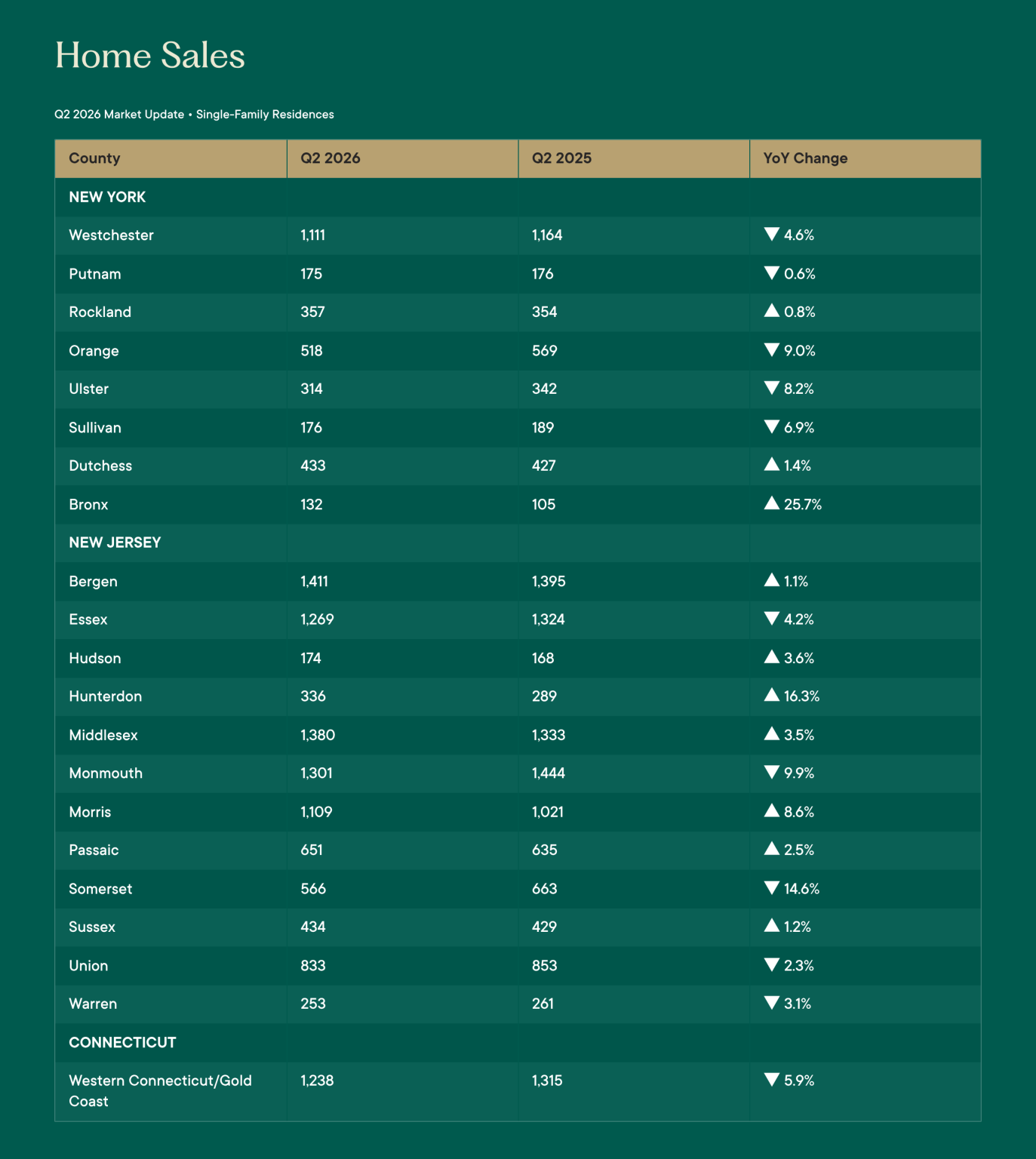
Despite the mixed transaction volume picture — with several counties posting year-over-year sales declines driven more by constrained supplythan by weak demand — price appreciation remained broadly positive across the region, underscoring the structural imbalance that has definedthis housing cycle. The Bronx was a notable bright spot on the volume side, with closed sales jumping 25.7% year over year as buyers priced out ofmore expensive submarkets continued to find relative value at a $700,000 median. Hunterdon County similarly stood out in New Jersey, recordinga 16.3% increase in sales and a meaningful rise in new listings, suggesting that more inventory-rich outer-ring markets are successfully absorbingdemand. Taken together, Q2 2026 reinforces a regional market in which geography, price point, and commute proximity to New York City continue to act as the primary sorting mechanisms for both buyer urgency and seller leverage.
